


About Us
Aviator Helena Cato & Family
Independent, accomplished achievers

Hobart Cato, wife Mary, Yootha and Helena
Hobart Edward Cato
(Born in Wellington NZ 1883 - died Clare 1967)
Also known as Harry or “Hec” from his initials
Was an underage messenger attached to the Cavalry in the Boer War
Later ran a sewing machine and bicycle repair shop in Benoni, South Africa
Moved to Melbourne with his family of two girls.
In 1912 left the girls in a convent school and he went to England to learn aviation and got caught there by the First World War.
He first worked for Sopwith Engineering Company as a mechanic and test pilot. Other Australians there were Harry Hawker (Chief Test Pilot) and Harry Kouper.
Cato and Kouper developed the Sopwith-Kouper interrupter gear, which synchronised a machine gun to fire a thousand rounds a minute though a revolving propeller.

Hobart was born in 1881 in Wellington, New Zealand, the son of Frederick William Cato and his wife Sophy, nee Burgess. The family moved from Wellington to Victoria some time around 1892.
He was a mechanic by trade, having gained his skills at the Federal Cycle Works in Burke St, Melbourne, VIC.
From about 1899 until 1901 he was a mechanic with the Singer Manufacturing Co. in Melbourne before enlisting in the 1st Scottish Horse in South Africa and serving as a Trooper in the Boer War in 1901 and 1902[1].
He then worked as a mechanic for the East Rand Motor Co. in South Africa until 1905 when he started his own business, the Klunfontein Motor Co. in South Africa where he worked as owner/mechanic until 1908 when he returned to Melbourne, VIC.
Hobart married a British Army nurse Mary Elizabeth Bidlestone in South Africa and seems to have stayed on after the war.
On return to Australia they settled in Clare.
During World War One he was involved in the aircraft industry where he developed several patents for aircraft equipment.
Postwar he ran a mechanical repair garage as well as maintaining an interest in aircraft.
In 1921 he was flight mechanic to Lieutenant Long in the record breaking flight Adelaide to Melbourne in a De Haviland Dove aircraft.
He was also involved in the origins of motorcycle racing in Port Pirie.
In 1926 he traveled 2066 kilometres through the distant outback of South Australia in a T model Ford claiming to have only used 145 litres of fuel (7.82 litres per 100 km) and 9.1 litres of oil.
His daughter Helena was only the second woman to gain her pilots licence in South Australia. In 1940 he was a member of the RAAF recruiting and pre selection committee in the area.
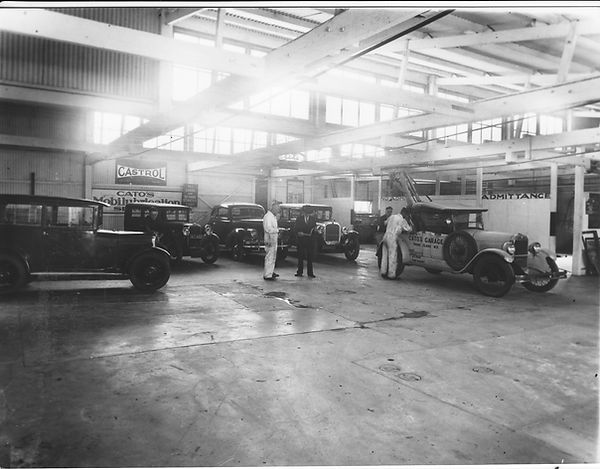
Cato's Garage
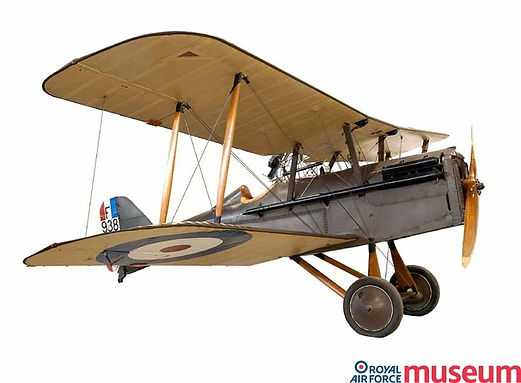
In late 1914 or early 1915 Hobart Cato joined the Royal Flying Corps and later the Royal Navy Air Service for which he was awarded the Queen’s Medal.
During this time he flew planes from England to Europe and went on bombing runs in Belgium dropping bombs by hand over the side of the plane.
In the navy he flew Sopwith seaplanes which were catapulted off the war ships by steam (A very hit and miss manoeuvre).
When he returned to Australia he ran the first newspaper run around Victoria’s south Coast (Geelong area) by dropping the papers from a Gypsy Moth and also did a bit of “barn storming”.
He came to Clare as a aircraft mechanic for Dudley Angas and later built Cato’s Garage (now WSB Distributors).
He built a single seater plane called the Flying Flea while he was there.
When the Second World War started he sold the premises to the government as an ammunition factory and worked in the Hendon munitions factory in Adelaide.
He flew planes until 1939.
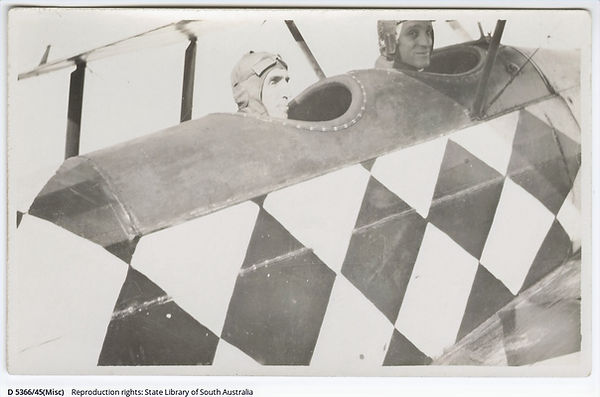
In 1921 Hobart was flight mechanic to Lieutenant Long in the record breaking flight from Adelaide to Melbourne in a De Haviland Dove aircraft;
owned by Mr. Dudley Angus of Hill River estate.

Helena Cato with her parents Mary and Hobart Cato
at Cato's Garage
Hobart came to Clare as a aircraft mechanic for Dudley Angas and later built Cato’s Garage (now WSB Distributors).
He built a single seater plane called the Flying Flea while he was there.
When the Second World War started he sold the premises to the government as an ammunition factory and worked in the Hendon munitions factory in Adelaide.
He flew planes until 1939
Meet The Cato Team


Patricia, Jack Lloyd, David, Helena (nee Cato)
- WRITTEN BY 88 YR OLD , RECOLLECTIONS FROM WHEN SHE WAS ABOUT 6 OR 7 YRS OF AGE
(by David Lloyd's older sister, Patricia)
Let's describe this garage. There was a large central space; I suppose to manoeuvre vehicles, and where I learned to roller skate, and to ride a bike, both in circles.
Across the back beside the front of the Maxwell (ute) was a big car wash area where the mud was hosed and manual washed from cars, their interior cleaned and the windows shiny and body polished to be like new and a pressure hose setting to get the mud from under cars too.
On the same back wall beside the car wash were shelves usually with car batteries being recharged, and above mounted high on the wall a cylinder of gas.
Just now I do not remember if that was just for the welding work so often needed to repair crashed cars, or if it had to do with pumping up the inner tubes which came to use to make riding in cars more comfortable.
Previously the tyres were hard and all the bumps were felt, and many roads were dirt tracks, busier roads were graded, muddy or dusty.
Depending on the weather, the car wash was a busy section. I think spare tyres came to Clare on the train and they were always wrapped in a hundred pieces of curled card all about 2 inches wide and each had to be pulled off to unwrap a tyre. I loved to play patterns on the floor with all those curly bits.
Tyres then had an inner tube, and yes they were often punctured, and a flat tyre stopped a car, which had to be jacked up on the road and the spare replacing it before it could drive on. So, repairing flat inner tubes was a daily task, as was charging batteries and washing and polishing cars.
Beside the battery charging area Pa had big sliding doors, they separated the work shop from the area where I pedalled my little car. They could work on 3 cars each behind a sliding door and only the mechanics were allowed into that section.
They used to work under a car by lying on a canvas stretcher with casters and push themselves about.
They wore long sleeve white overalls, always spotless (and Nana kept them so) and the area was all painted white and it was also spotless.
Level with the battery charger, but behind the sliding doors, along the back wall Pa had (later I learned it was a big ship sized) metal turning lathe which he used often and in fact he made tools to fit certain jobs he needed to complete.
The cars, in for service, which back then was an oil change and grease every 3 months, or cars in for repair after accidents, all faced the work bench wall which was beside the vacant block of land next door and on the main street.
Big drums of various oils for the car oil changes, and the drums were stacked along the wall backing to the house where we lived.
The usual driveway entrance was beside the high counter with a glass display case of spare parts and things, and the enormous cash register furthest from the section of counter which lifted, or I could walk under.
Behind there was a big shelved and hidden area with all sorts of spare parts and each week there was a stock run, Nana and my mother and me took the weekly drive to Adelaide to pick up new stock most had been order by phone and was ready for us to collect.
Parked in one corner of his garage was a car Pa cut down and today would be called a ute, He had it rigged with a crane and quite often had to go, and in all weathers and night or day to tow broken down or crashed vehicles and bring them in for repair.
Actually the person with the good business brain was my great grandmother. She ran the business and did all the accounting.
Cato was the engineer, automotive and aeronautical. He was one of the lead engineers at Sopwith during the WW1 and brought that skill back to Australia to work on planes here, including the one his daughter flew.
Certainly to have served in 3 wars ( Boer, WWI and II), to lose his successful business during WWII was a big blow.
He was good at marketing his business, my mother (Helena) recalls.
I remember another trip not dissimilar to down by the Coorong, cars followed a track not a road, to the great lakes near Mt. Gambier. There is a quick- sand trap along there and we stopped for hours to help pull a car back out and shared the rug and tucker with those people for that day.
These trips West, were solely for the purpose for Pa to paint advertising signs for Cato's garage in massive white letters on suitably located rocks along the route that bold tourists took if they motored to Perth or in that direction.
(Has anyone one seen those painted signs out there??)
His was the last, or the first, depending on their travel direction, garage with petrol and all needs and repairs and spare parts before folk ventured beyond.
He owned a vehicle he had set up with a crane on the back, it was a ute; before utes were made fashionable and was a Maxwell - long before Holdens and so on.
On one occasion it actually towed a tour bus back to the garage for repair. My mother had to make several trips to fetch the passengers.
David thinks the family banned the above author Patricia from driving about a year ago (2024).
Then his sister died a couple of months ago (2025) aged 96.

David Lloyd with pedal car at the family farm on Spring Farm Rd. Clare
Aviator Helena Cato


Helena and Patricia at Parafield
Helena Adeline CATO was born on 27 March 1907 in Benoni, Gauteng, South Africa, when her father, Hobart, was 26, and her mother, Mary, was 25.
Hobart was born in New Zealand to Australian parents and Mary was born in England.
She arrived in Australia when she was nine months old and went to a Catholic boarding school in Melbourne thought to be Presentation College. Little is known of her earlier schooling.
At the boarding school she was taught by French nuns and learned, among other things, to do fine needle work and to play the piano. She made two wedding dresses and worked on large tapestries all her life.
In 1920 when she was 13 she sat for the Melbourne University examination in Pianoforte Grade III and in 1921 passed with honors (honours) in the examination in Piano Playing Grade III.
She became a concert pianist and played with 2 orchestras and many concerts around South Australia.
The ABC offered her a contract to play on live radio before the days of record players in studios but her father wanted her to help in his motor garage in the Clare main street, the building now occupied by WSB Distributors.
Helena came to Clare in 1923 to work for her father as a garage Jack of all trades where her father expected her to do a man’s work despite her size and femininity.
“I lifted wooden cases holding two four-gallon tins full of petrol, cleaned plugs and cars and mended punctures for clients,” said Helena.
“When I was 17 I learnt to drive a Model T Ford and then naturally with a father so interested in flying I became interested in that too,” she said.
Helena had her first flight when she and her sister Yootha went up with her father to persuade customers to go with Hobart for joy rides.
When business was slow he took both his daughters up to show how safe it was.
Her first experience in an aeroplane was probably at the age 11 or 12 when her father was offering joy flights in Melbourne and needed to show that flying was quite safe and took Helena and sister Yootha for a few circuits.
In 1931, as Hobart was an aviation engineer and pilot, trips were often made to Parafield aerodrome, her mother persuaded Helena to try for her pilot’s licence.
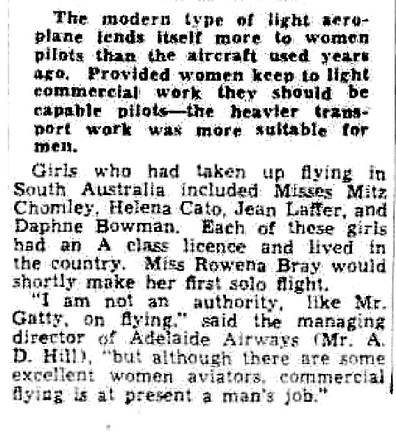
Thus this young woman took the controls under the guidance of the Parafield Aero Club on 22 October 1931, and she obtained her ticket on 26 January 1932.
She flew Tiger Moth and Gypsy moth bi-planes.
She took her first flying lesson in November 1931 and passed her “A” ticket 3 months later. One newspaper reported that she was the first to get her licence and another said that she was the second.
In October 1932 she was 1st in the cross country race to Bute and the next month passed her advanced licence. Her first of many passengers was her father.
Her log book lists many activities including height judging, blind flying, paddock landings, bombing practice (dropping flour bombs on a target) and forced landings. She had quite a collection of trophies in her cupboard.
Her daughter Patricia can remember sitting on Charles Kingsford Smith’s knee while watching her mother doing loop the loops in her plane.
Helena flew in aero competitions participating in gliding and climbing events and blind flying by compass winning trophies for each event.
“I found piloting an aircraft an exhilarating experience especially one day when I was above the clouds with the sun reflecting in such a way that it formed a circular rainbow with my tiny plane in the centre of the circle.”
On one flight she brought Father Christmas to the Stanley Flat Hall children’s party via the Clare Race Course.
Helena was studying for her commercial licence and also planning a flight to England when it is assumed that the depression and World War II denied her of achieving her ambitions.
She later became deaf in one ear and said she then could not balance a plane. Later in life she had an operation to fix the problem and was able to pilot a glider for a short flight.
Helena comes from a long line of very strong determined independent women.
For example her mother, Mary, left England on her own to work in South Africa after the Boer War and met her husband Hobart, who had stayed on to work in South Africa.
They married in South Africa and returned to Melbourne Australia when she was pregnant with their second child, Helena’s younger sister Yootha.
Helena’s GG grandmother Sarah Simpson (age 41) and 9 children, including Great Grandmother Hannah Nichols (age 17) emigrated in 1835 to Hobart, Tasmania Australia from London in the first “woman’s” only transport ship.
Sarah’s husband had passed away and she had 11 children, one stayed in England and one son was already in Tasmania, having been transported as a convict in 1829.
One has to be inspired by the courage of Sarah to pack up her family for the colony and this determined spirit for adventure, to overcome adversity can be seen in Helena.


Helena Lloyd
A customer arrived at the garage one day having come from Pt Augusta and having two cars break down on the trip.
He told Hobart that he needed to get to Adelaide to catch the Melbourne express. If he missed the train he would miss his wedding in Melbourne.
The train left Adelaide in an hour and a half. Hobart went to get the driver and when Helena appeared the man said that he wanted a driver not a girl and was told “take it or leave it.”
The Main North Road in those days was mainly dirt with many pot holes and sharp corners and was about 20Km longer than it is today and therefore the trip would need speeds of around 140–150 Km/Hr on the good sections.
On arrival at the Adelaide railway station they took his bags from the car and ran down the ramp just in time to see the tail end of the train leave the station. Back in the car and a quick trip to Mt Lofty station and this time they had more success.
The gentleman came through Clare eighteen months later and gave her a large box of handkerchiefs which lasted the rest of her life.
Three local men attempted to beat her record and they failed. The first didn’t make the start line by rolling his car heading down Inchiquin Hill, the second rolled his car on Penwortham Hill and we are not sure what happened to the third but he did not make it either.
Her daughter Patricia remembers that she once drove a passenger through to Melbourne with the fellow having to pay for fuel and meals along the way.
In 1927, Helena married Thomas Alfred Ryan and they had a daughter, Patricia, born in 1929. This turned out to be a violent marriage and she returned to her parents 3 years later.
To have the strength to walk away from a bad marriage in a time when that was highly frowned upon and to keep her daughter, when at the time it was considered better to have a child of a previous marriage adopted because it may improve your chances of remarriage.
Helena separated from Tom in 1930 and as the law required 7 years separation was finally divorced in 1937.

Patricia, Jack Lloyd, David, Helena (nee Cato)
Helena came down to earth to become a busy farmer’s wife, when she married Jack Lloyd, a son of the late Mr. Syd Lloyd of Spring Farm, Clare, and his wife, the former Florence Tilbrook, daughter of the founder of the Northern Argus.
Helena married Jack Merlyn Lloyd in 1938 and they had one son, David, born in 1939. Her log book lists J M Lloyd as a passenger on 31st October 1935.
Jack spent three years overseas during the war and Helena managed the farm with the help of a Mr Smith during this time.
The property was a mixed farm with cows to milk, currants and wine grapes, prunes, pears, walnuts, and sheep to manage. All this during a time of petrol and food rationing.
Shopping was done once a week and because of the petrol shortage it was necessary to walk the seven kilometres every second week.
One of her stories was on several of these trips during hot weather when she would meet her sister and they decided to go to the pub to enjoy a beer, however women were not to go into the hotel without a male escort even in to the ladies lounge.
The question was should she pick up a stranger because her husband was at the war (imagine what the gossips would say) or should they just go in by themselves (imagine what the gossips would say, loose women going to the pub.)
As it happened David aged 2 was the big brave male escort and received a delicious raspberry and lemonade for his effort.
Also during the war she helped raise money for the troops in various organisations, one being the Jabawocks card club that played Bridge at different members homes every month.
After the war she was always busy with jobs like painting the house and gardening, playing tennis and golf and at one time chair of the ladies golf in Clare.

Spring Farm, a mixed farm of vines and sheep, passed to the hands of her son, David, the fourth generation of the Lloyd family to farm it.
After the death of her husband, Helena became interested in wood carving, and her home bears testimony to her skill in this intricate art.
She had always loved the look and feel of polished wood, so, in 1972, she decided to master the art. Once again, she was encouraged by a member of her family, her daughter Pat, who gave her a set of wood carving tools to start her off.
Helena saw an advertisement in an Adelaide newspaper that Mr Bill Hoad took pupils at the Norwood Adult Education Centre, so she enrolled, driving the 172-mile return trip each week.
After Bill Hoad left adult education classes to take private students, Helena continued with him.
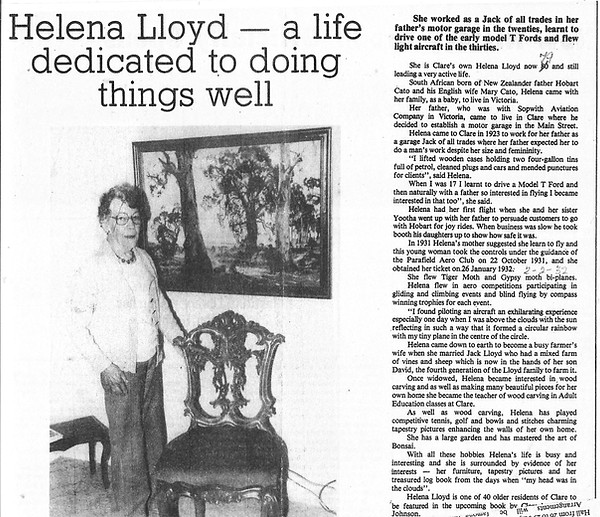
Interest in her beautiful work became apparent in Clare, so she was encouraged to become the teacher of wood carving in adult education, Clare, a position she held for five years.
Helena has a preference for Honduras mahogany and Nigerian mahogany, because of the ease of carving and the beauty of the finish.
She has made a superb seven-feet high china cabinet from Thailand cedar and Honduras mahogany, cutting out many of the pieces and carvings with a jig-saw. Other period-style furniture which she has made includes seven dining chairs, tables, and lamp stands.
Helena says that it is not a difficult craft the hardest part is the sanding down.
As well as her wood carving, Helena has played competitive tennis, golf and bowls, and stitches charming tapestry pictures, which enhance the walls of her home.
Helena had a large garden and expanded her interest in horticulture by mastering, a few years ago, the art of Bonsai.
With such a variety of hobbies, Helena’s life is a busy, interesting one, and the result of those interests surround her every day, with her furniture, tapestry pictures, and her treasured log book, from the days when her head was in the clouds.
Helena died on 21 August 1990 in Adelaide, South Australia, at the age of 83. Helena’s legacy is her family. 2 children, 7 grandchildren, 16 great grandchildren and at Nov 2017, 7 great, great, grandchildren. ( soon to be 8)


References:
-
A DESCRIPTION OF CATOS GARAGE - by elder sister Patricia
-
Helena Adeline Lloyd – nee Cato - Cracking the glass ceiling for woman in Australia (Lloyd Family Papers)
-
Helena’s story from the book: Clare Cameos compiled by Win Johnson – Published 1986
(available from Clare Regional History Group, Clare Town Hall)